Where to put balcony solar: every option, priced in kilowatt hours
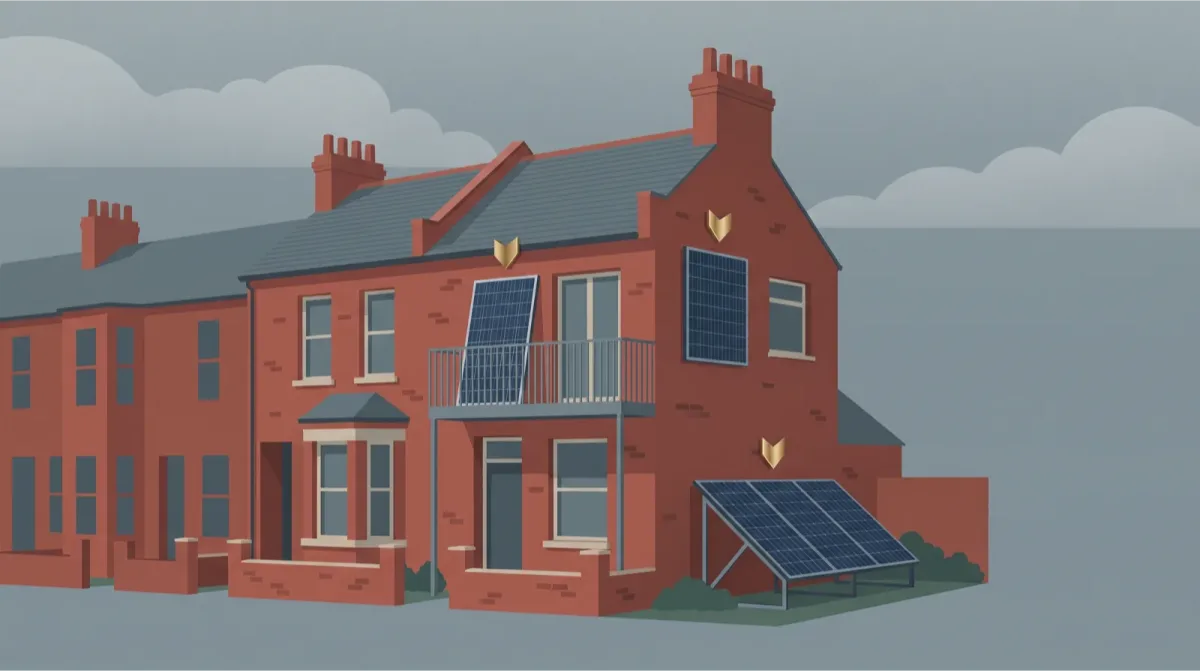
Balcony, garden or wall: a south-facing tilted panel makes 808 kWh a year in London, the same kit upright on a north-facing railing makes 162. Here is every placement option with its number, and the rules that rule half of them out.
Rules and product details last checked on .
Key takeaways
- Placement is worth up to five times more output. The same 800 W kit makes 808 kWh a year tilted south in London, and 162 kWh upright facing north. Nothing else about the kit matters as much as where you put it.
- The best spot you are allowed to use beats the best spot you are not. From 27 August 2026, fixing panels to a wooden balcony or garden fence loses permitted development rights; the planning rules and the numbers need to be read together.
- Vertical is not a failure. An upright south-facing panel loses about a quarter of annual output but gains 27 per cent in December, and its year is far flatter.
- The indoor half of the question matters too. The government specification says a kit may only be connected to a socket circuit, never to one supplying lighting or fixed equipment.
- Every number below is modelled from PVGIS for an 800 W kit, with the method published on our output page.
Most guides answer “where should I put my balcony solar?” with “somewhere sunny”. That is not an answer, it is a shrug. You are making a permanent trade between output, permission and safety, and each option in that trade has a number attached.
Here are the numbers, and the two rulebooks, planning and product safety, that rule some of them out.
What each placement produces
Modelled annual output for an 800 W kit in London, by orientation and tilt, from our published PVGIS dataset, retrieved 11 August 2026:
| Placement | Output (kWh/yr) | vs best |
|---|---|---|
| South, tilted 30 degrees on a frame | 808 | best case |
| South-east or south-west, tilted | 771 | -5% |
| South, upright on a railing (90 degrees) | 594 | -26% |
| South-east or south-west, upright | 559 | -31% |
| East or west, tilted | 662 | -18% |
| East or west, upright | 417 | -48% |
| North, tilted | 466 | -42% |
| North, upright | 162 | -80% |
Three readings worth taking from that table.
Tilt matters more than most guides admit, except on railings where you have no choice. Going from 30 to 90 degrees costs a quarter of annual output, south-facing. If your balcony forces vertical, plan on 594, not 808.
East and west is a real option. An east-facing panel loses the evening and keeps the morning; at tilt the penalty is only 18 per cent, and if you are out all day and home in the evening, a west-facing panel’s output arrives when you can actually use it. Orientation and self-consumption trade against each other, and our calculator lets you price that for your own day.
North is not a option. A north-facing upright panel makes one fifth of the best case. If north is all you have, the honest answer is that the money is better spent on something else.
Where you are not allowed to put it
Two separate rulebooks govern the outdoor half of the question, and they bite in different places.
The planning rulebook. On 27 August 2026, the same day the product becomes legal, a planning order removes permitted development rights for plug-in solar fixed to timber: a wooden balcony, a timber-clad block of flats, or a garden fence. That is not a ban, but it means applying for planning permission instead of proceeding freely. Our guide to what the planning rules allow covers this in full, including the free-standing garden limits: one panel, at most nine square metres, five metres from the boundary.
The product safety rulebook. The government’s Plug-in Solar Device Interim Product Specification, version 2.0 imposes requirements on mounting that no general guide mentions:
- The attachment must be “reversible and non-permanent”, and must not compromise the building’s structure, fire performance or weatherproofing.
- It must survive wind and snow. The mounting “shall be designed such that foreseeable wind and snow loading does not result in detachment, instability and falling components”, and manufacturers must state the maximum installation height for each mounting type, calculated to BS EN 1991-1-4:2005+A1:2010. A fourth-floor railing and a ground-floor patio are different engineering problems.
- You are responsible for escape routes and fire spread. The instructions must warn you to keep rescue paths clear and to install panels “in a way that does not increase the risk of fire spreading along external walls or balconies to neighbouring properties”.
- Not on boundary structures. Panels must not be fixed to walls or parts of the building that form a property boundary between dwellings.
The practical summary: a metal railing or a free-standing frame in your own garden, mounted to the manufacturer’s instructions, clears both rulebooks. A drilled hole through a timber balcony clears neither without paperwork.
The indoor half: which socket
Placement does not end at the wall. The specification is specific about the other side of it: “Plug-in solar device shall only be connected to socket circuits and not to circuits supplying lighting or other fixed equipment.”
That has a practical test you can do in a minute. Switch off breakers one at a time and see which sockets lose power: everything that dies together is one circuit. Your kit goes on a socket circuit, ideally the one feeding the room where you use the most daytime electricity, because power consumed on the same circuit as the panel is used most directly. And the specification’s note on network rules is stricter still: one device per household, not one per circuit.
No extension leads, no multi-way adaptors, no RCD adaptors: all prohibited by the same document. If the socket does not reach, the panel moves, not the cable.
Shade, spacing and the one-panel-per-box rule
Shading costs less than it used to, but not nothing. Because each panel in a kit has, or shares, its own microinverter, a shadow on one panel no longer collapses the whole string, the way it does on a rooftop array. It costs you only the shaded panel’s share. The specification also requires minimum spacing between modules, which is partly self-shading: two panels leaning against each other shade each other’s lower edge all day.
What shading does not forgive is obstruction you chose. A panel behind a balustrade’s glass panel, under a projecting lintel, or inside a recess will spend its life in diffuse light, and diffuse light is what Britain has most of. Before committing a wall, watch it at noon on a bright overcast day: if the panel’s own shadow is soft or absent, the spot is a poor one.
The winter trade-off nobody mentions
Upright is worse over a year, and better in the season you care about most. Our winter guide found that a vertical London panel produces 27 per cent more than a tilted one in December, because the winter sun is low and a vertical face meets it squarely. Over the year the tilted panel wins by a third; between the best and worst month, the upright panel varies by 1.8 times against the tilted panel’s 3.8.
Since winter units are the units most likely to be consumed rather than exported for nothing, the money gap is narrower than the kilowatt-hour gap. Railing buyers are not choosing second-best; they are choosing the flatter year.
What we have verified, and what we have not
Verified on 23 August 2026. Every yield figure in the table, from our PVGIS dataset retrieved 11 August 2026 with its method published; the mounting requirements quoted from the Interim Product Specification; the socket-circuit rule; the timber exclusions and garden limits, quoted in the planning guide.
Not verified. Your balcony. Wind loading at your height, your railing’s condition, your building’s cladding and your lease or tenancy are specific to you, and the specification puts those assessments partly on the manufacturer’s instructions and partly on you.
Our editorial policy explains how we handle modelled figures.
This page carries the date it was last checked. If a rule or a figure has moved, tell us and we will verify it against the source and update the date.