Where are you allowed to put a plug-in solar panel?
A planning order in force from 27 August 2026 stops you using permitted development rights to fix plug-in solar to a wooden balcony or a garden fence. Those are the two places most renters would choose.
Rules and product details last checked on .
Key takeaways
- Not on a wooden fence, and not on a wooden balcony. From 27 August 2026 a planning order removes permitted development rights for plug-in solar fixed to timber, including timber-clad blocks of flats.
- That is not an outright ban. It means the easy route stops applying, and you would have to apply for planning permission instead.
- Free-standing panels in a garden have their own limits: one only, no more than 9 square metres, and not within 5 metres of your boundary.
- Your tenancy is a separate question, and a kit that is not fixed to anything may not engage the alterations clause at all.
- If you own a leasehold flat, a clause requiring consent for improvements cannot be applied unreasonably. That has been the law since 1927.
- These planning rules are England and Wales only.
Three different people can say no to you, and they say no for different reasons. The council, through planning. Your landlord, through your tenancy. Your freeholder or management company, through your lease. Most guides treat these as one question. They are not, and the answers do not point the same way.
The planning one has just changed, and almost nobody has noticed.
The planning rule nobody is talking about
On 27 August 2026, the same day plug-in solar becomes legal to connect, a second instrument comes into force: the Town and Country Planning (General Permitted Development) (England) (Amendment) Order 2026.
It writes plug-in solar into planning law for the first time, defining it as:
solar photovoltaics that are intended for connection to the relevant domestic premises’ electricity installation by means of a standard plug and socket
And then it takes something away. For equipment fixed to a building, the order inserts a new exclusion:
(f) in the case of plug-in solar, where any part of the plug-in solar would be installed on a wooden wall, balcony or enclosure or on any part of the exterior of a block of flats which is clad in timber.
For free-standing equipment in your garden or yard, it inserts a matching one:
(d) in the case of plug-in solar, any part of the plug-in solar would be installed on a wooden fence, gate, wall or other means of enclosure.
Read those two together and the practical effect is blunt. The two most obvious places a renter would put a panel, a wooden balcony and a garden fence, are both outside permitted development from the day the product becomes legal.
What that actually means
It does not mean you are banned from doing it. Permitted development is a shortcut: it grants planning permission automatically so you do not have to apply. Losing the shortcut means you would have to make a planning application and have it decided on its merits.
For a £400 kit, that is usually enough friction to change your plan. Mounting on masonry, on a metal railing or on a free-standing frame keeps you inside the easy route.
The reason for the restriction is not stated in the order, but the pattern, timber plus electrical equipment plus blocks of flats, points at fire safety rather than appearance.
If the panel stands on the ground
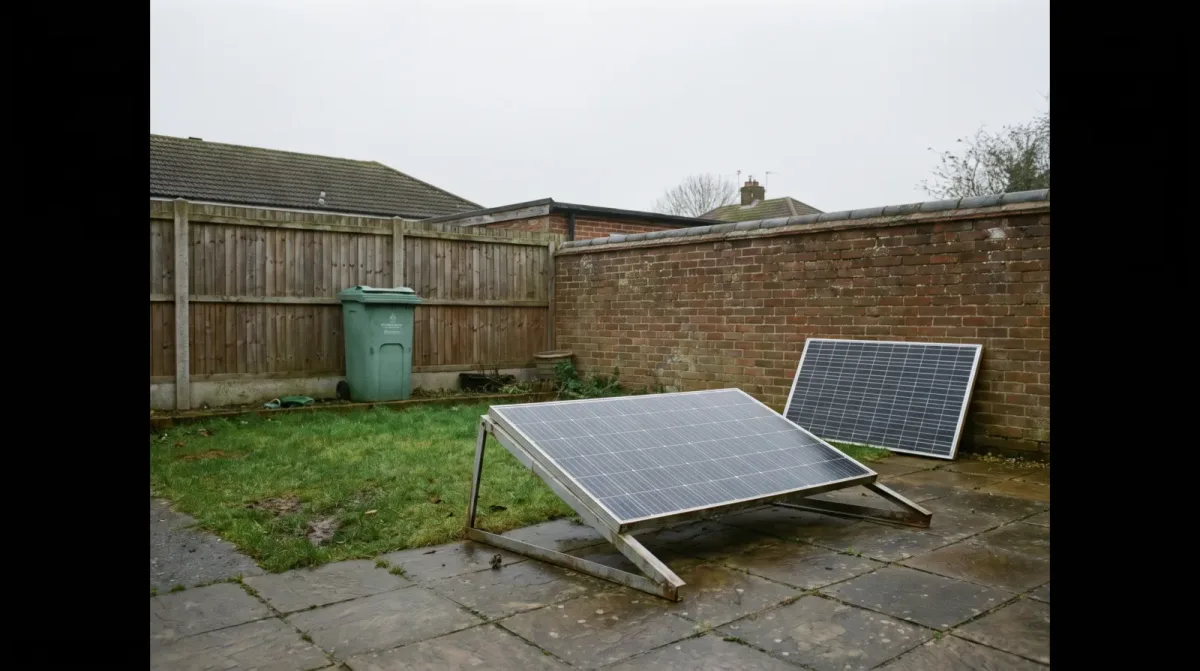
Free-standing solar in your garden or yard is covered by a separate class, Class B of Part 14 of the GPDO, which applies within the curtilage of a house or a block of flats. It has limits worth knowing before you buy:
| Limit | Value |
|---|---|
| How many | One stand-alone installation within the curtilage |
| Panel area | No more than 9 square metres |
| Any array dimension | No more than 3 metres |
| Height | No more than 4 metres, or 2 metres in a conservation area near a highway |
| Distance from your boundary | Not within 5 metres |
| Listed buildings, scheduled monuments | Excluded |
The five-metre rule is the one that catches people. A typical terraced back garden is under ten metres wide, which leaves almost nowhere that is five metres from every boundary. If your outdoor space is small, free-standing may not be the permitted route either.
Nine square metres, for what it is worth, is generous: an 800 W kit is usually about four.
England and Wales only
That order extends to England and Wales. Scotland and Northern Ireland run their own planning systems, and we have not checked either. If you are in Edinburgh or Belfast, treat this section as background and check your own regime.
This is the second time the two halves of the UK have diverged on this subject. The other is that the network-side rules do not reach Northern Ireland at all.
Can your landlord stop you?
Different question, different answer, and it starts with a distinction that matters more than people expect.
Most tenancy alterations clauses are about fixing things to the building. Drilling, screwing, altering the structure. A kit that stands on a frame on a patio, or rests on a balcony floor weighted rather than bolted, and plugs into an existing socket, may not engage that clause at all, because you have not altered anything. The government’s guidance for private renters is the place to start on what your agreement can and cannot require.
Fix it to a wall or a railing and you are plainly in scope, and you should ask.
Two things a landlord can reasonably raise, and it is worth having answers ready:
- Damage on removal. Answered by a mounting method that leaves no holes.
- Electrical safety. Answered by the kit being certified as a complete package, and by notifying the network operator as the rules require.
Whether your landlord is legally required to be reasonable if they do refuse is its own question, with more nuance than most sites give it. We have set out what the statutes actually say, including a specific claim about the Renters Rights Act 2025 that turns out not to be true, in our guide to whether your landlord can refuse plug-in solar. Read your own agreement, and if it is ambiguous, ask in writing so you have the answer in writing.
If you own a leasehold flat
Here the law is more helpful than most leaseholders realise, and it is nearly a century old.
Section 19(2) of the Landlord and Tenant Act 1927 provides that where a lease contains a covenant against making improvements without consent, that covenant is deemed subject to a proviso:
such licence or consent is not to be unreasonably withheld
And it applies “notwithstanding any express provision to the contrary”. A lease cannot contract out of it.
The freeholder is not powerless. The same section lets them require payment for any damage or reduction in the value of the premises, and for their reasonable legal costs of granting consent. But “no, because we would rather not” is not a position the Act supports.
Whether a plug-in kit is an “improvement” at all is the prior question, and it turns on the same point as the tenancy one: if nothing is fixed to the building, there may be nothing to consent to.
What we have verified, and what we have not
Verified against the primary source. The definition of plug-in solar inserted into the GPDO, both new exclusions covering timber, the commencement date of 27 August 2026, the England and Wales extent, the stand-alone limits, and the wording of section 19(2) of the 1927 Act. All quoted above from legislation.gov.uk.
Not verified. How councils will interpret “wooden wall, balcony or enclosure” in practice, since the order is not yet in force. Whether an unfixed panel amounts to development at all. Whether any given tenancy or lease clause is engaged, which depends on its wording and not on ours.
Not covered. Scotland and Northern Ireland planning, and building insurance, which we are looking at separately.
We are not planning lawyers and this is not legal advice. It is a careful reading of the instruments, with links so you can check us. Our editorial policy sets out how we handle this.
Before you decide where to put it, it is worth knowing what it would produce there: a north-facing wall may be the only permitted spot and still not be worth it. Every placement option, with its annual output figure, is set out in where to put balcony solar.
This page carries the date it was last checked. The planning order is new and untested; if you have had a decision from a council on plug-in solar, tell us and we will add what it shows.