Does plug-in solar work in a British winter?
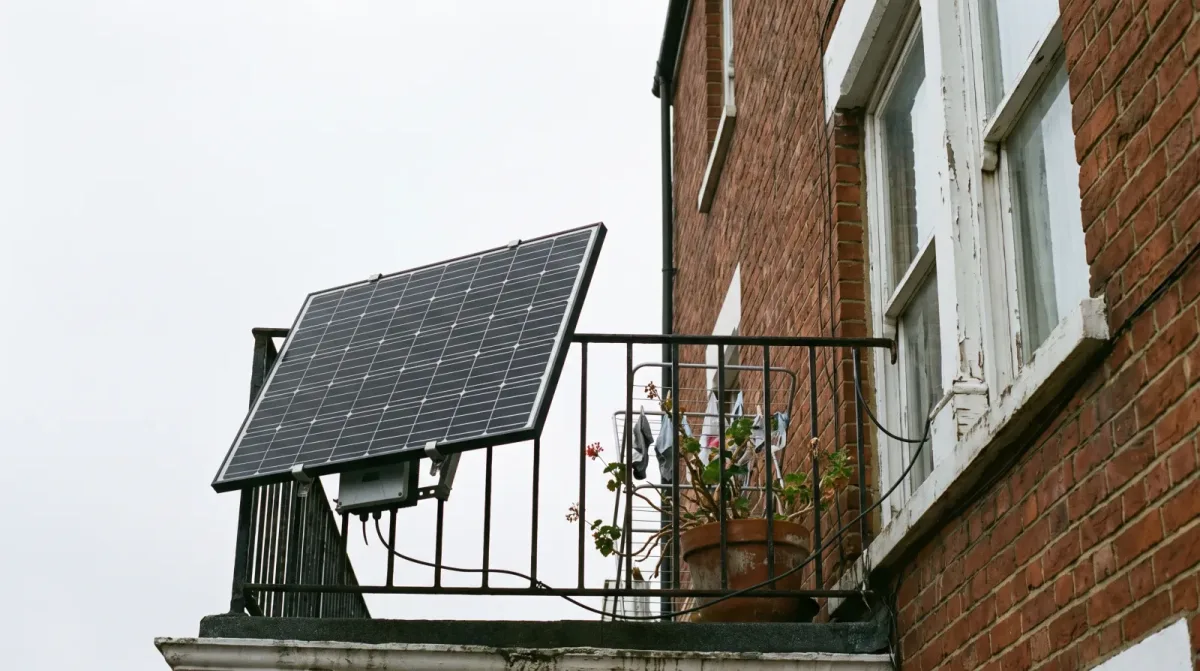
Yes, and a panel flat against your railing does it better than a tilted one. In December a vertical panel in London produces 27% more than the same panel angled at 30 degrees. Here is the data and why it happens.
Rules and product details last checked on .
Key takeaways
- A December day in London gives an 800 W kit on a railing about 1.1 kWh. That is roughly a load of washing, not nothing.
- Vertical beats tilted in winter. In December the upright panel produces 27% more than the same kit angled at 30 degrees, and it wins from November through February.
- The upright panel loses badly in summer, down 50% in June, which is why it still loses about a quarter over the year.
- But it gives you a much flatter supply: 1.8 times between best and worst month, against 3.8 times for a tilted panel.
- Winter kWh are worth more than summer kWh, because in winter you are far more likely to be using them rather than exporting them for nothing.
Yes, and the mounting most renters are stuck with turns out to be the one that handles winter best. That is not the answer we expected when we ran the numbers, and it changes the advice.
What a winter day actually gives you
We modelled an 800 W kit in London, facing south, in two positions: flat against a balcony railing at 90 degrees, and tilted on a frame at 30 degrees.
| Month | Tilted 30° | Upright 90° | Difference |
|---|---|---|---|
| January | 0.99 kWh | 1.19 kWh | +20% |
| February | 1.46 | 1.51 | +3% |
| March | 2.19 | 1.83 | −16% |
| April | 3.05 | 2.05 | −33% |
| May | 3.12 | 1.72 | −45% |
| June | 3.33 | 1.68 | −50% |
| July | 3.23 | 1.69 | −48% |
| August | 2.86 | 1.76 | −38% |
| September | 2.51 | 1.93 | −23% |
| October | 1.71 | 1.64 | −4% |
| November | 1.21 | 1.42 | +17% |
| December | 0.88 | 1.12 | +27% |
Figures are kWh per day, averaged over the month. Source: PVGIS, European Commission Joint Research Centre, queried 12 August 2026. 0.8 kWp of panels, 14% system losses, due south, London coordinates. Modelled, not measured.
Over a year the upright panel produces 594 kWh against 808 kWh tilted, so the railing still costs about a quarter of the total. But look at the shape rather than the total.
Why the upright panel wins in December
Nothing mysterious. In midwinter the sun in Britain barely gets above about 15 degrees at noon. A panel lying back at 30 degrees is pointing most of its face at the sky rather than at the sun. A panel standing upright is pointing at the horizon, which in December is roughly where the sun is.
In June the reverse applies. The sun is high, the tilted panel faces it, and the upright one is edge-on to most of the light.
The result is that a vertical panel has a much flatter year. Between its best and worst month it varies by 1.8 times. The tilted panel varies by 3.8 times.
Why flatter is worth more than it looks
A kilowatt hour is not worth the same in June as in December, because savings depend on using the electricity as you generate it. Anything you produce and do not use is exported, and a plug-in kit earns nothing for it.
In June, a tilted panel making 3.3 kWh a day is producing far more than a flat sits idle all day can absorb. Much of that goes out to the grid for free.
In December, a vertical panel making 1.1 kWh a day is producing into a home that is dark by four, has the lights on, and is far more likely to be occupied. Very little of it is wasted.
So the summer loss is partly a loss of exported units you were never paid for, while the winter gain is a gain of units you actually use. The gap between the two mountings, in money, is narrower than the gap in kilowatt hours.
This corrects something we wrote. Our guide to what plug-in solar produces says that if you have any choice about the angle, take it. That is right if you want the largest annual number. It is too simple if what you want is the largest saving, and we have added a note there.
So should you tilt it or not?
Honestly, it depends on your day.
Tilt it if the space allows, if you are home during summer days, or if you have an export arrangement that pays for surplus. The annual total is meaningfully bigger.
Leave it upright without feeling you have compromised if your railing is the only option, if the household is out on summer days, or if you care more about a steady contribution than a big July number. You are giving up about a quarter of the annual energy for a much better winter and less waste.
What you should not do is conclude that a railing makes the whole thing pointless. It does not.
One planning caveat before you fix anything to that railing: from 27 August 2026, under the planning order that comes into force that day, you cannot use permitted development rights to mount plug-in solar on a wooden balcony or fence. Metal railings and masonry are unaffected.
You can compare positions for your own city with our savings calculator.
What we have verified, and what we have not
Modelled, with the method stated. All figures come from PVGIS, the photovoltaic geographical information system published by the European Commission’s Joint Research Centre, queried on 12 August 2026 with the parameters given under the table. PVGIS uses long-run satellite irradiance data, so a real year will be better or worse.
Not measured by us. We have not metered a panel over a winter. When we have, we will publish what it did rather than what the model said.
Assumes no shading. In winter the sun is low, which makes shading from buildings and trees worse than in summer. A model cannot see your neighbour’s roof.
Our editorial policy sets out how we handle modelled figures.
This page carries the date it was last checked. If you have metered a plug-in kit through a British winter, tell us: real numbers beat modelled ones and we would rather publish yours.