What can you actually run on 800W of plug-in solar?
A kettle, no. A fridge, usually. The honest answer depends on the difference between a continuous load and a momentary one, and the rating plate on the appliance settles it either way.
Rules and product details last checked on .
Key takeaways
- A legal plug-in kit tops out at 800 W of AC output, roughly a fifth of a typical rooftop system. That number decides everything on this page.
- A kettle is the clearest no. UK kettles are rated between about 2,000 and 3,000 W, two to three times the entire legal ceiling on their own.
- A fridge or fridge-freezer is usually a yes. Its continuous running draw is typically well under 800 W, though the compressor pulls a brief, much higher surge when it switches on, which is a different thing from what it draws once it is running.
- The distinction that matters is continuous versus momentary. A plug-in kit offsets whatever your home is steadily drawing at that instant. Appliances with a short, high-power spike, kettles, toasters, hair dryers, are the ones that blow past the ceiling even though they only run for a couple of minutes.
- The rating plate on your own appliance is the only number worth trusting fully. Manufacturer figures vary by model, and this page gives typical ranges, not a guarantee for the specific fridge in your kitchen.
The honest answer to “will this run my fridge” is not a yes or no list. It is a rule, and once you have the rule you can check anything yourself.
The rule: continuous load, not total appliances
A plug-in kit does not power one device you plug into it. It feeds your home’s wiring at the socket, and whatever is drawing electricity on that circuit at that moment draws on the panel’s output first, automatically, explained in full here. The question is never “can this system run my fridge and my kettle and my laptop at once”, because it does not work by allocation. The question is “what is my home’s continuous load doing right now”, and whether that figure sits under the 800 W the microinverter can legally deliver.
That means the appliances that matter most are the ones running continuously in the background, not the ones you switch on briefly.
Appliances that usually fit
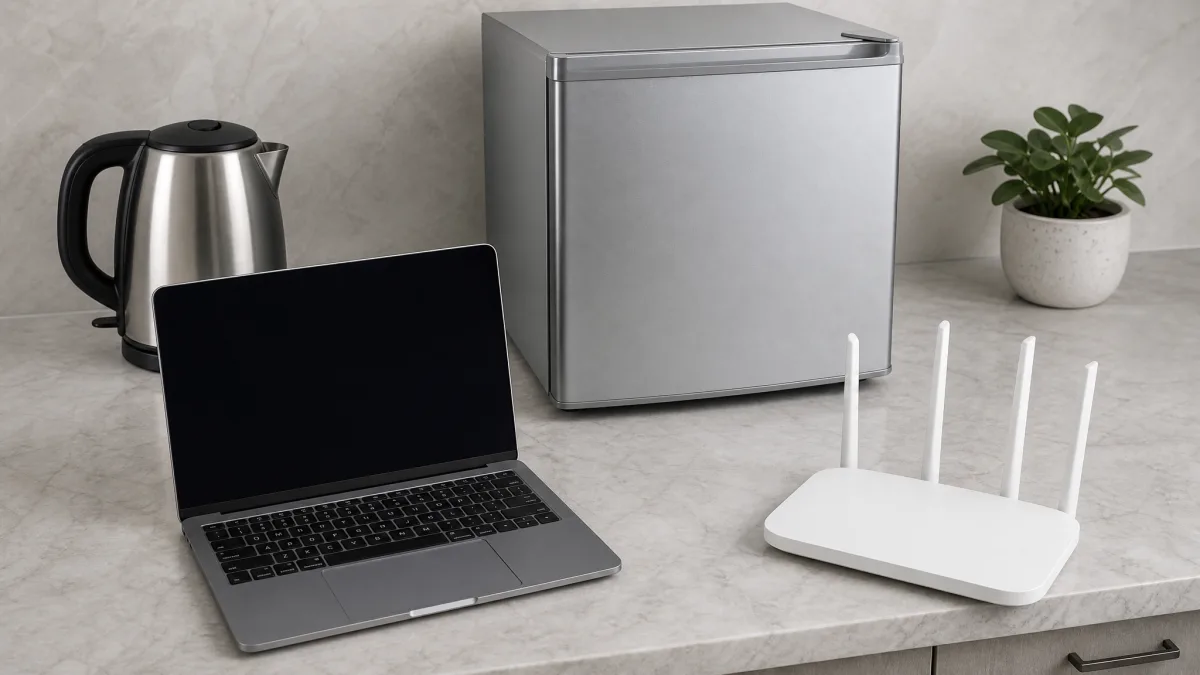
A fridge or fridge-freezer. Multiple appliance guides put a typical combination fridge-freezer’s continuous running draw in the range of roughly 100 to 200 W, comfortably inside the 800 W ceiling. The compressor’s start-up surge, when it kicks in every so often, is briefly higher than that, in the same way a kettle spikes when it starts, but a single appliance’s short surge is not the same load-shape problem as an appliance that draws its full rating for the several minutes it takes to boil water.
A WiFi router. Typically in the range of 5 to 15 W, negligible against the ceiling.
A laptop, charging. Typically 45 to 65 W depending on the model and charger.
Lighting, LED bulbs specifically, typically single-digit watts each.
A modern TV, while on. Typically in the range of 50 to 100 W for an LED set, though larger and older models draw more.
Run several of these at once and you are still generally well inside 800 W, which is exactly the kind of background, always-on load this category of product is built to offset. It is why we describe it as a top-up to your baseline usage, not a replacement for your supply.
Appliances that do not fit
A kettle. UK kettles are commonly rated between roughly 2,000 and 3,000 W. Even the lower end of that range is more than double the entire legal ceiling on a plug-in kit.
A toaster, a hairdryer, an iron. The same shape of problem as a kettle: a genuinely high wattage for a short period. None of these are within reach of an 800 W system, however briefly they run.
A washing machine, on a heating cycle. The motor alone might sit within range, but the heating element that warms the water pushes total draw well past 800 W for as long as it is heating.
An electric shower or immersion heater. Both routinely draw several kilowatts, an order of magnitude beyond what this category of product is designed for.
How to check your own appliance rather than trust a typical figure
Every mains appliance in the UK carries a rating plate, usually on the back or base, stating its power draw in watts. That figure, not a typical range from a guide like this one, is the one to trust for a specific decision. If a plate states watts directly, that is your answer. If it states amps instead, multiply by 230, the UK’s nominal mains voltage, to get watts.
What this means for how much you actually save
Knowing what a kit can offset in the moment is one half of the picture. The other half is how much it generates across a real day and a real year, which is data we have modelled city by city, not guessed, and placement makes up to a five-times difference on its own. Timing your background usage, running the appliances above while the panel is actually producing, is what turns the 800 W ceiling into a real reduction on the bill rather than a number on a spec sheet.
What we have verified, and what we have not
Verified against the primary source. The 800 W AC ceiling itself, quoted from the statutory instrument in our legality guide.
Given as a typical range, not a verified figure for any specific model. Every appliance wattage on this page. These vary by manufacturer, model and age, and we have not tested a specific product against its rating plate. Where we say “usually” or “typically”, that is the qualifier doing real work, not decoration.
Our editorial policy explains why we would rather give a range with that caveat than a single confident number we cannot stand behind.
This page carries the date it was last checked. If a figure here looks wrong for a common appliance, tell us with the model and rating plate and we will correct it.