How do plug-in solar panels actually work?
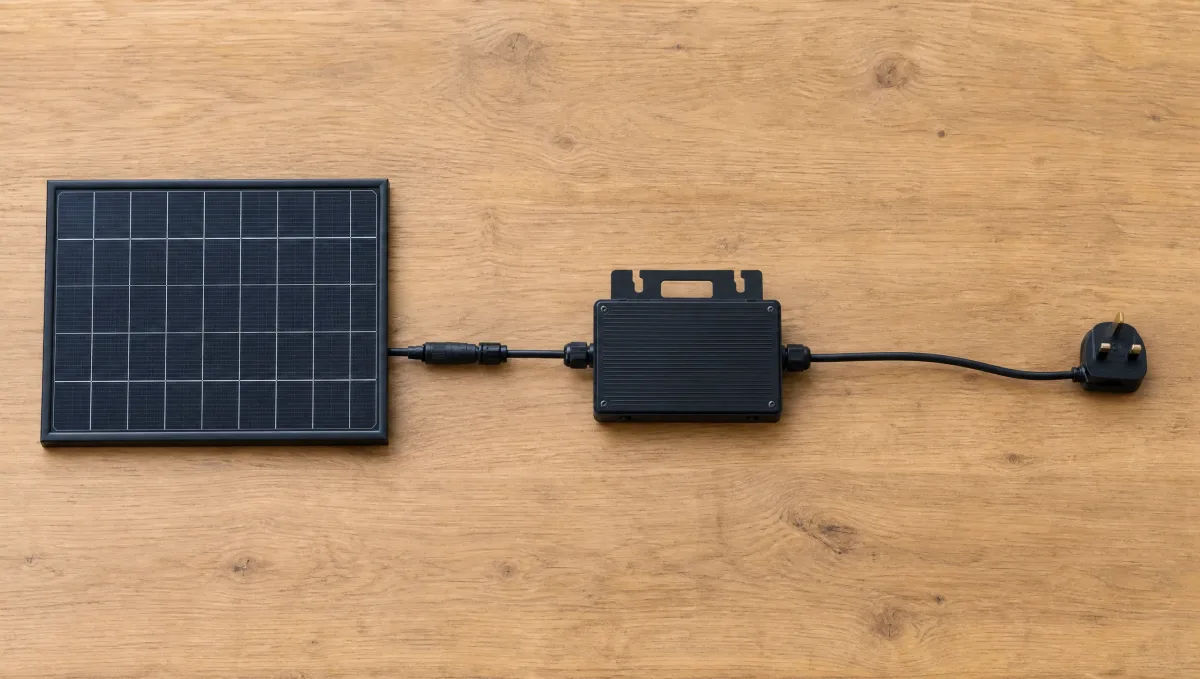
Three parts, in plain terms: a panel that makes DC, a box that turns it into AC, and a plug that feeds it into whatever in your home is switched on. Here is each part, and the one safety feature that makes the whole thing legal.
Rules and product details last checked on .
Key takeaways
- Three parts, in this order: panel, box, plug. The panel makes one kind of electricity, a small box called a microinverter turns it into the kind your home uses, and a normal plug feeds it in.
- Nothing in your house knows the difference. Once the electricity is through the microinverter, your fridge, router or lamp draws on it exactly like it draws on the grid. There is no special socket or setting.
- It cannot power your whole home, and is not meant to. A legal kit tops out at 800 W. That covers small, always-on loads, not a kettle or a shower.
- The safety part is what makes plugging into a wall legal at all. The microinverter has to sense when the grid goes down and cut itself off within 100 milliseconds, which is what stops it from being dangerous to anyone working on the lines outside.
- If you want the wattages, currents and standards behind this rather than the plain-English version, we cover those separately.
Think of it as a solar panel with a normal plug already on the end, rather than a smaller version of the panels on somebody’s roof. That is the whole idea, and almost everything about how it works follows from it.
Part one: the panel makes the wrong kind of electricity
A plug-in solar panel works the same way any solar panel does. Sunlight hits the cells and knocks electrons loose, which produces electricity. The type it produces is called direct current, DC, the same type a battery produces. Your home does not run on DC. It runs on alternating current, AC, which is what comes out of every socket in your house. A panel on its own, with nothing else attached, has no legal way to connect to anything.
Part two: the microinverter fixes that
The box that solves this problem is called a microinverter, usually a small weatherproof unit about the size of a hardback book, fixed behind or beside the panel. It takes the DC electricity in and sends AC electricity out, matched to the UK’s 230 V, 50 Hz supply. This is the component the law actually regulates: the legal limit is 800 W of AC output from this box, not the panel’s own rating, which is why some kits are sold with more powerful panels than their output figure suggests. We unpack exactly what the government specification demands of this box, wattage by wattage, in our microinverter guide.
The microinverter does a second job at the same time. It watches the grid’s own signal, and if that signal disappears, because of a power cut or maintenance work outside, it disconnects itself within a tenth of a second. This is not a nice-to-have. It is the specific feature that makes it safe for an engineer to work on a supposedly dead line without your panel feeding it electricity from your balcony. Every legal kit has to do this; a kit that does not is not legal, whatever the listing says.
Part three: the plug feeds it into your home, not into a device
The cable ends in an ordinary UK plug, which goes into an ordinary socket. From there, the electricity joins your home’s existing wiring at that circuit, the same as anything else plugged in nearby. It does not have its own pathway to one appliance. Whatever is drawing power on your electrical installation at that moment, a fridge, a router, lights left on, draws on the panel’s output first, automatically, before drawing from the grid. You do not choose what it powers, and you cannot direct it to one device.
If the panel is generating more than your home is using at that instant, the surplus does not get stored anywhere in a basic kit. It goes out onto the grid, and because a plug-in kit is not eligible for the Smart Export Guarantee, that surplus is not paid for. This is why timing your usage, running things while the sun is on the panel, matters more with this kind of system than with a rooftop array that has a battery behind it.
What this rules out
Two things follow directly from how the system works, and both catch people out.
It will not power a kettle, a shower, or anything that draws a lot for a short time. The 800 W ceiling is a fifth of what a typical rooftop system delivers, and kettles alone often draw close to that on their own. This is a top-up to your background usage, not a replacement for your supply.
It stops working the moment the grid does, even in daylight. Because the microinverter has to disconnect when it loses the grid’s signal, a plug-in kit gives you no power during a cut, unlike an off-grid battery system. That trade-off is what makes it safe to plug into a wall in the first place.
Where this fits with everything else on the site
This page explains the mechanism. Three other pages answer the questions that follow from it:
- Whether this is legal to do at all, and under what conditions: is plug-in solar legal in the UK.
- What you actually have to tell your network operator, and when: DNO notification, explained.
- What a real kit costs and what you get for it: our buying guide.
What we have verified, and what we have not
Verified against the primary source. The DC-to-AC conversion, the 800 W AC limit, and the disconnection requirement on loss of mains, all confirmed against the statutory definition and the government’s Interim Product Specification, covered in full technical detail in our microinverter guide.
Simplified deliberately. This page trades precision for plainness in places, for example describing “your home’s wiring” rather than the specific circuit a kit must be connected to. Where the precise wording matters, for a legal or safety decision, read the linked guides rather than relying on the plain version here.
Our editorial policy explains the difference between a simplified explanation and an inaccurate one, and how we try to stay on the right side of it.
This page carries the date it was last checked. If a simplification here reads as misleading rather than plain, tell us and we will fix it.