EcoFlow RIVER 3 in the UK: what it is, what it is not, and who should buy it
The RIVER 3 is a 245 Wh, 300 W portable power station at £249. It is not plug-in solar and will not cut your bill. It can keep a router, laptop and lights running in a power cut. Here is the honest version.
Rules and product details last checked on .
Key takeaways
- The EcoFlow RIVER 3 is a 245 Wh battery with a 300 W AC output, listed at £249 on EcoFlow’s UK page on 30 September 2026. A 600 W “X-Boost” mode covers short surges.
- It is a portable power station, not plug-in solar. It charges a battery and you plug appliances into the box. It does not feed your home and does not reduce your electricity bill.
- Its real use is a power cut or a camping trip. A router, phone, laptop and a few LED lights are well within reach; a kettle is not.
- If you are here to cut your bill, you want a balcony kit, not this.
- Bigger siblings exist. The RIVER 3 Plus and Max have more capacity and output, but their UK pricing was not listed when we checked.
“EcoFlow RIVER 3” gets more searches than any plug-in solar product, and most of the people searching it are not the people this site is for. So here is what it does, and where it stops.
What it is
Per EcoFlow’s own page, the base RIVER 3 stores 245 Wh, delivers 300 W of AC power, can surge to 600 W using X-Boost, and switches to battery in under 20 milliseconds if the mains fails, which is what “UPS mode” means. Those are the manufacturer’s figures; we have not tested the unit.
What it can run
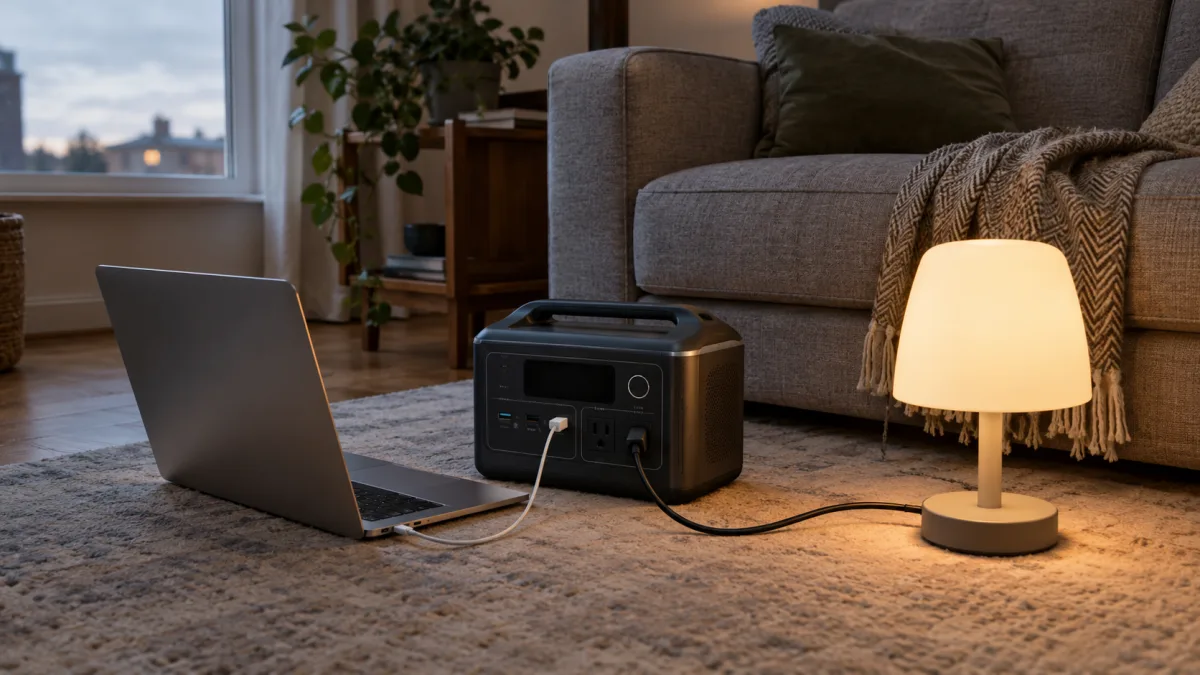
Watt-hours divide by watts to give hours, so this is arithmetic rather than a test. At a steady 50 W, a router and a phone charger, 245 Wh lasts a little under five hours. At 150 W, a laptop, router and a lamp together, about an hour and a half. Real runtime is lower because of conversion losses.
We covered what appliances an 800 W supply can carry. The 300 W ceiling here is much lower. A kettle, at roughly 2,000 to 3,000 W, is out of the question, and so is anything with a heating element.
What it is not
Two things get confused in search results.
It is not plug-in solar. The category the law created is a device that feeds your home’s wiring in parallel with the grid, defined in the statutory instrument. A power station does the opposite: it isolates its own supply. That is why no network operator notification arises for one, and also why it does not offset a single kilowatt hour on your bill.
It is not a way round the rules. Plugging it into a solar panel to charge is fine; that is what the solar input is for. But charging a battery from your panels and then using it in the evening is a slow, small way to use your own generation, not a substitute for a grid-connected kit.
Who should buy it
- Anyone who wants power in an outage. For a router and phones it is enough to stay connected for hours.
- Campers and van users. The task it is designed for.
- Not renters looking for lower bills. For that, the buying guide is the page to read.
What we have verified, and what we have not
Verified against the seller, 30 September 2026. The RIVER 3 capacity, output, surge, switchover time and £249 price, from EcoFlow’s UK page.
Not verified. Real-world runtime, solar-charging speed, and any specification of the Plus and Max models, whose UK prices were not listed. We have not tested the hardware.
Our editorial policy explains how we handle claims we cannot check.
Prices move quickly. If you see a different live price, tell us and we will verify it.